Two Stages, One Signal: What India's AI Moment Is Really Telling Us About the Future
Two of India's most important technology gatherings, one signal: India is no longer asking whether AI will change the future — it's negotiating what role it will play in shaping it.
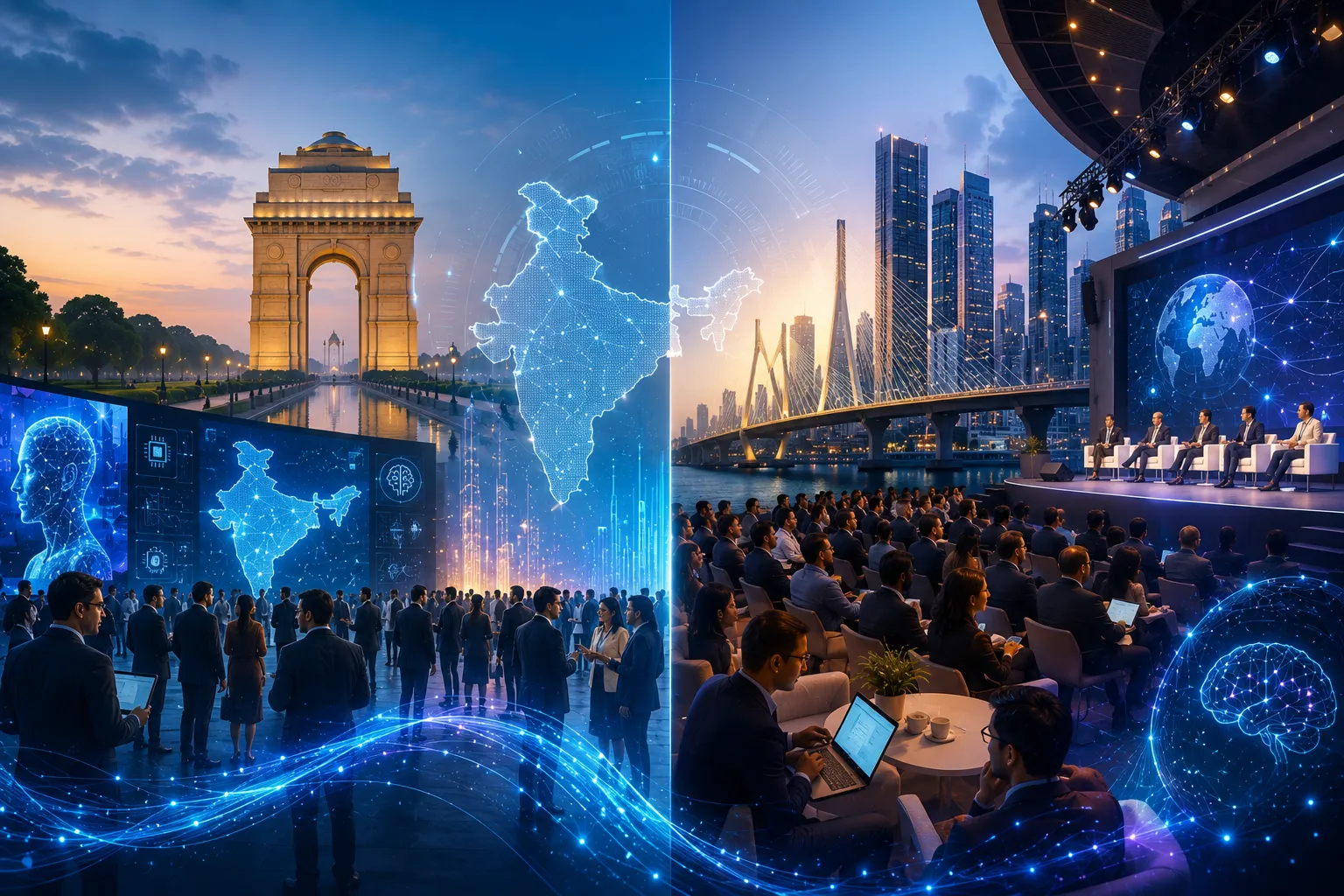
In February 2026, I had the opportunity to attend two of India’s most important technology gatherings:
- The India AI Impact Summit 2026 in New Delhi
- The Nasscom Technology & Leadership Forum 2026 in Mumbai
Different cities. Different audiences. Different tones.
But if you listened closely, both events were saying the same thing:
India is no longer asking whether AI will change the future. It is negotiating what role it will play in shaping that future.
After keynote speeches, leadership panels, startup showcases, investor conversations, and countless corridor discussions — here are my key takeaways and what they signal for the decade ahead.
AI Has Moved From Experimentation to Infrastructure
At the AI Impact Summit, the vocabulary centered around human-centric AI, sovereign models, digital public infrastructure, inclusion, multilingual systems.
At Nasscom, the language shifted to revenue transformation, productivity gains, non-linear growth, AI orchestration, margin pressures.
Two lenses — policy and industry.
One reality:
AI is no longer a side initiative or innovation lab experiment. It is becoming core infrastructure — economic, institutional, and strategic.
Just as cloud became foundational over the past decade, AI is now embedding itself into every layer of enterprise architecture and governance.
The shift is profound:
- From AI as a feature → to AI as a foundation
- From pilot projects → to scaled deployment
- From innovation teams → to boardroom strategy
This is no longer about “adopting AI.” It’s about restructuring around AI.
India’s IT Identity Is Undergoing a Structural Shift
For decades, India’s global tech identity was built on scale — talent depth, delivery excellence, and cost efficiency.
At Nasscom, there was clear acknowledgment that traditional effort-based service models are under pressure. AI reduces manual intensity, compresses timelines, and automates layers of execution.
But what stood out to me was this: There was no denial. There was recalibration.
The conversation is shifting toward:
- From manpower-led services → to AI-led orchestration
- From billing by hours → to billing by outcomes
- From cost arbitrage → to intelligence arbitrage
This is not incremental evolution. It’s a redesign of business DNA.
If Indian firms execute this transition well, they don’t become smaller in the AI era — they become strategically indispensable.
Sovereign AI Is Not a Political Slogan. It’s a Strategic Imperative.
At the AI Impact Summit, sovereign AI infrastructure was a central theme — indigenous models, semiconductor supply chain partnerships, public digital platforms, multilingual AI systems.
It would be easy to interpret this purely through a nationalist lens.
But the deeper reality is risk management.
AI systems depend on:
- Compute infrastructure
- Training data
- Foundational models
- Cross-border supply chains
In a geopolitically sensitive world, dependency equals vulnerability.
India’s push for local capability is less about isolation and more about resilience.
However, ambition must now meet execution. Building sustainable AI ecosystems requires:
- Long-term capital
- Research depth
- Academic-industry collaboration
- Regulatory clarity
- Global interoperability
Intent is visible. Execution will determine credibility.
The Employment Question Is Real — But It’s Being Reframed
Across conversations in Mumbai, one theme kept surfacing: employment anxiety.
Hiring growth is slowing. Automation is rising. AI agents are entering workflows.
But here’s the nuance:
The dominant narrative wasn’t “AI will eliminate jobs.” It was “AI will redefine jobs.”
The future workforce will not be:
- Pure coders
- Pure analysts
- Pure designers
It will be professionals who can:
- Work with AI systems
- Validate and supervise AI outputs
- Translate business context into machine prompts
- Integrate multi-disciplinary insights
The growth model is becoming non-linear. Revenue may grow without proportional headcount expansion.
India’s demographic dividend becomes meaningful only if reskilling outpaces automation.
This is the single biggest execution challenge of the next decade.
Governance Will Determine Trust — And Trust Will Determine Scale
The AI Impact Summit also sparked debate around regulatory safeguards, human rights protections, and enforceable governance frameworks.
This tension is healthy.
Because the next phase of AI growth will not be determined only by technical capability — but by legitimacy.
We are entering a period where:
- Enterprises will evaluate AI partners on ethical maturity.
- Governments will demand explainability.
- Consumers will reward transparency.
Innovation without governance creates volatility. Governance without innovation creates stagnation.
The winners will balance both.
India has an opportunity here — especially given its experience building digital public infrastructure at population scale.
Market Volatility Is a Transitional Phase — Not a Verdict
Recent investor nervousness around Indian IT reflects uncertainty:
If AI reduces manual effort, what happens to traditional revenue models?
History offers perspective.
Cloud disrupted on-premise revenue models. Automation disrupted BPO intensity. Platformization reshaped enterprise software margins.
Each phase created short-term turbulence before new equilibrium emerged.
AI will follow a similar arc.
The firms that:
- Cannibalize their own legacy models early
- Invest deeply in proprietary AI capabilities
- Redesign pricing around outcomes
…will define the next growth cycle.
This is less about survival. It’s about courage to self-disrupt.
The Real Signal: India Is Thinking at Scale
What struck me most across both summits wasn’t individual announcements or projections.
It was scale of ambition.
- Scale of participation
- Scale of economic projection
- Scale of digital infrastructure thinking
- Scale of global positioning
India is not positioning itself merely as an AI adopter.
It is signaling an aspiration to become a co-architect in the global AI order.
Whether it succeeds depends on three things:
- Speed of institutional adaptation
- Depth of ecosystem collaboration
- Ability to align policy, capital, and talent
What the Next 10 Years May Look Like
Based on what I observed, here is a forward-looking view for 2026–2035:
AI Will Become Invisible Infrastructure
It will power operations quietly — from public services to enterprise workflows.
Human-AI Collaboration Will Be the Default
Performance will depend on how effectively professionals augment intelligence with systems.
Outcome-Based Technology Models Will Dominate
Effort-based billing will increasingly give way to impact-based partnerships.
Ethical AI Will Become a Competitive Differentiator
Trust will not be a compliance checkbox. It will be a market advantage.
India’s Global Role Will Expand — If Execution Matches Narrative
The ambition is evident. The discipline of execution will define the outcome.
My Personal Reflection
Walking through crowded exhibition spaces in Delhi and listening to strategic recalibration conversations in Mumbai, one thought stayed with me:
We are not at the peak of AI hype.
We are at the beginning of AI restructuring.
The conversation has matured. The urgency is real. The anxiety is visible. The opportunity is historic.
The defining question for India is no longer:
“Can we participate in the AI economy?”
It is:
“Can we shape its direction?”
Summits create signals. Sustained action creates outcomes.
February 2026 felt like a signal moment.
The next decade will reveal whether it becomes a structural inflection point.